

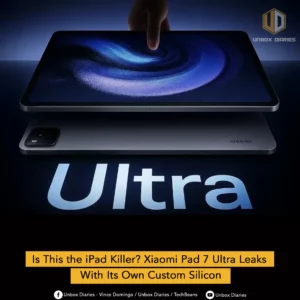
Xiaomi decides to throw a massive curveball. The highly anticipated Xiaomi Pad 7 Ultra has officially popped up on Geekbench, and it’s not just another high-end tablet — it’s showcasing Xiaomi’s brand-new, in-house developed SoC, the Xring O1. This isn’t merely a powerful new device; it’s a bold statement, and frankly, it’s got me genuinely buzzing.

As GSMArena was quick to report, the Pad 7 Ultra’s appearance on Geekbench isn’t just about the raw scores (though we’ll definitely dig into those!). It’s about Xiaomi confidently putting its own silicon, the Xring O1, directly into a top-tier device. This is a monumental, strategic move for the company, echoing the kind of ecosystem control and optimized performance that Apple has achieved with its M-series chips in iPads. Could Xiaomi truly be aiming for that same level of seamless integration? It absolutely looks that way.
The Xring O1 chip is undeniably the main event here. Multiple reliable sources, including NotebookCheck.net and India Today, have confirmed that this marks Xiaomi’s ambitious re-entry into the mobile SoC (System on a Chip) space. It’s reportedly built on TSMC’s 3nm process, which is cutting-edge technology, putting it squarely in the same league as Qualcomm’s Snapdragon 8 Elite series and Apple’s latest A-series Pro chips. That, my friends, is some seriously high-stakes competition!
Now, while the Geekbench scores for the Pad 7 Ultra’s version of the O1 chip (we’re seeing 2,191 for single-core and 8,741 for multi-core) are a tad lower than what we’ve heard from the rumored Xiaomi 15S Pro (which is also expected to feature the O1), that’s not necessarily a red flag. As folks in the GSMArena comments section are already pointing out, tablets often get slightly different clock speeds optimized for sustained performance and better thermal management over peak bursts, especially with such a thin profile. The fact that Xiaomi is confident enough to debut this chip in a flagship tablet speaks volumes about its fundamental capabilities. We’re definitely looking at a robust 10-core CPU setup with some impressive clock speeds!
Beyond the revolutionary new chip, the Xiaomi Pad 7 Ultra is shaping up to be an incredibly formidable piece of hardware. NotebookCheck.net’s recent deeper dive highlighted some truly compelling rumored specs:
- A Massive 14-inch OLED Screen: This isn’t just big; it’s expansive. Just imagine creating content, diving into movies, or serious multitasking on a canvas this size. And yes, it’s OLED, so expect those inky blacks and incredibly vibrant colors to pop.
- That “Wide Notch” for 3D Face Recognition: Okay, a notch on a tablet might raise an eyebrow or two at first glance, but it’s reportedly there for a reason: housing advanced 3D face recognition technology. Think Apple’s Face ID, but for an Android tablet. That’s a neat blend of security and convenience.
- Beast of a Battery: With a rumored 12,000 mAh battery, this tablet is absolutely built for endurance. And despite that truly gargantuan cell, it’s supposedly incredibly thin at just 5.1mm – that, my friends, is a genuine feat of engineering!
- Blazing Fast Charging: Xiaomi isn’t skimping on its signature 120W wired charging, which means you’ll be juicing up that massive battery in what feels like mere moments.
Naturally, it’s expected to run on Android 15 with HyperOS, Xiaomi’s refined custom UI, and come packed with a hefty 16GB of RAM, ensuring smooth performance even with your most demanding apps. Plus, expect full support for a dedicated keyboard and stylus, truly positioning this device as a no-nonsense productivity powerhouse.
Xiaomi’s decision to power its top-tier tablet with an in-house chip isn’t just a product launch; it’s a bold declaration of intent. It clearly signifies a long-term vision to control its own destiny in the semiconductor space, potentially leading to that highly optimized hardware-software integration that can finally rival the very best in the business. FoneArena, for instance, notes that Xiaomi has already invested over $1.8 billion in the Xring O1’s development and has plans to pour significantly more into chip design over the next decade. This isn’t a one-off experiment; it’s a foundational shift in their strategy.
With a major launch event reportedly set for May 22 (that’s tomorrow!), where the Xring O1 and the Pad 7 Ultra are expected to be officially unveiled alongside the Xiaomi 15S Pro and even an electric car (because, why not go all out?), the excitement is definitely reaching a fever pitch. Xiaomi isn’t just making a tablet; they’re showing us a vivid glimpse into their future, one increasingly powered by their very own silicon. And frankly, for anyone who cares about where mobile tech is headed, that’s incredibly exciting to watch unfold.
If you liked this article, check out our other articles on Xiaomi.