

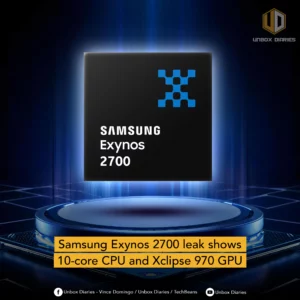
Samsung’s next flagship mobile processor reportedly named the Exynos 2700, has surfaced in an early Geekbench listing, offering a first look at its CPU configuration and graphics hardware months before any official announcement. The appearance suggests Samsung is already testing the chip on internal hardware likely tied to future Galaxy flagship models.

Unlike its predecessor, the Exynos 2600, which used a typical three-cluster design, the leaked Exynos 2700 adopts a 10-core, four-cluster architecture.

According to the listing, the chip includes:
- 1 core at 2.30 GHz
- 4 cores at 2.40 GHz
- 1 core at 2.78 GHz
- 4 cores at 2.88 GHz
This layout spotted on an Engineering Reference Device running Android 16 with 12 GB of RAM indicates Samsung is trying new scheduling and performance strategies rather than sticking strictly to traditional big-middle-little cluster setups.
The Exynos 2700 is also listed with the Xclipse 970 GPU, which replaces the Xclipse 960 seen in the current generation. Early OpenCL results show a score of 15,618 points lower than the Exynos 2600’s roughly 25,791 score, but this is likely due to the prototype nature of the chip and unoptimized drivers rather than final retail performance.
Prototypes often underperform because they are tested on Engineering Reference Device boards with early software, so final silicon in consumer devices expected around 2027 could show significantly improved graphics numbers.
The presence of a deca-core CPU and a next-generation GPU in early testing suggests Samsung is refining its SoC architecture ahead of what’s likely to be a new flagship wave, potentially the Galaxy S27 series even as the Exynos 2600 is slated to debut with the Galaxy S26 lineup later in 2026.
Rumors outside the benchmark listing also point to the Exynos 2700 being manufactured on Samsung Foundry’s second-generation 2nm process (SF2P) with Gate-All-Around (GAA) technology, aimed at improving performance and efficiency over previous nodes. Expectations also include support for LPDDR6 memory and UFS 5.0 storage, which align with flagship-level demands.
Check out our other articles on Samsung: